Can Social Justice and Capitalism Truly Coexist? Jay-Z, Black Activism, and the Business of Justice

Written by The Perspective Desk
Published by Provoking Perspectives
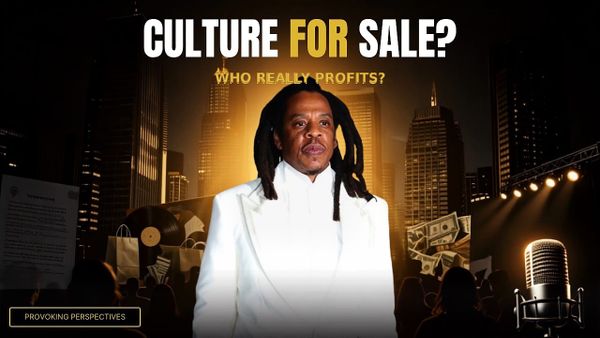
In today’s culture, wealth and activism often collide. Celebrities speak the language of justice while building brands, securing partnerships, and expanding business empires. That tension forces us to ask an uncomfortable but necessary question: when wealthy public figures profit from the image of social justice, are they advancing the movement — or using the movement to strengthen their brand?
Jay-Z is one of the clearest examples of this contradiction. He is not only one of the most successful artists in hip-hop history, but also a powerful businessman, investor, and cultural figure. At the same time, he has been publicly connected to criminal justice reform, prison reform, legal advocacy, and conversations around racial inequality.
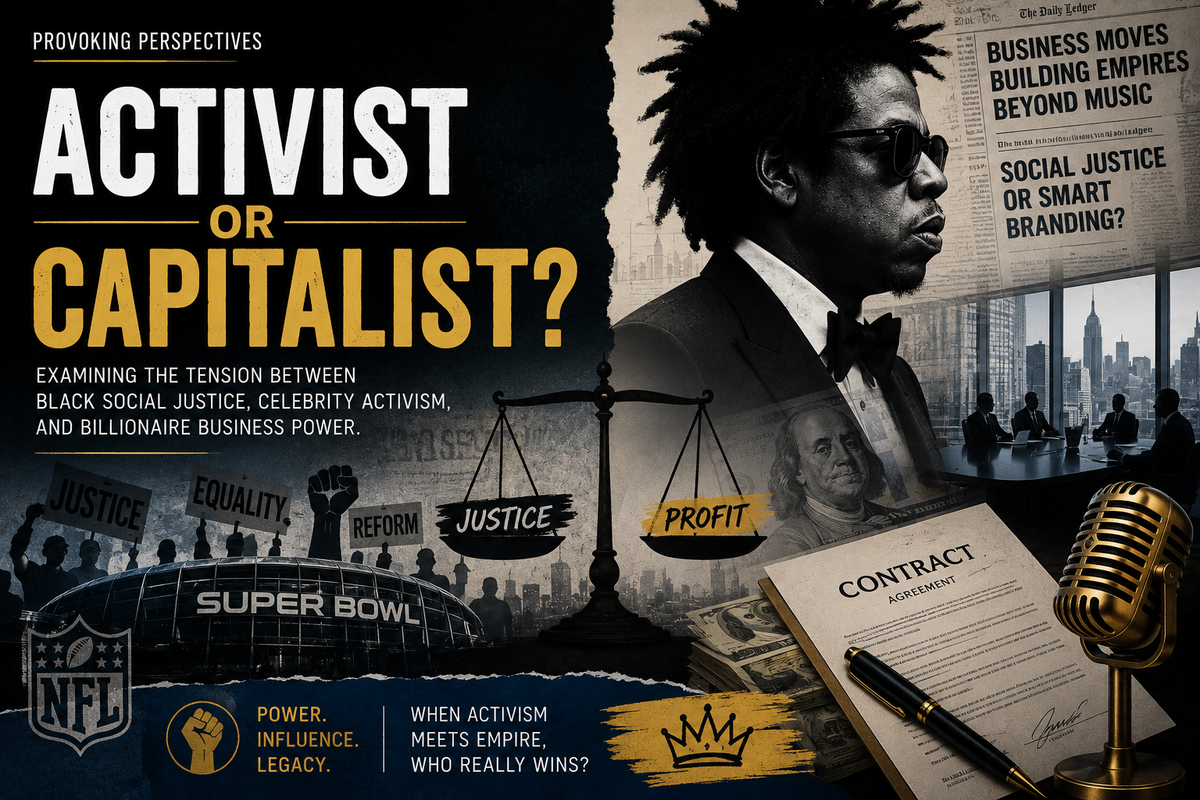
So the question is not simply whether Jay-Z has done anything meaningful. He has been connected to real social justice efforts, including Roc Nation and Team Roc’s work around criminal justice reform and police accountability. Roc Nation also entered a long-term partnership with the NFL in 2019 that included entertainment and social justice initiatives connected to the league’s Inspire Change program.
The deeper question is this:
Can a billionaire capitalist truly serve social justice without being limited by the very system that made him powerful?
That is the tension. That is the contradiction. And that is the conversation we need to have.
The Paradox of Wealth and Activism
Many people admire Jay-Z because he represents ownership, strategy, and financial success. He turned music into a business empire. He moved from artist to executive, from performer to power broker. For many Black people, that kind of success feels inspiring because it challenges a long history of exclusion from ownership and wealth.
But admiration should not cancel analysis.
Capitalism is built around profit, ownership, expansion, and market power. Social justice is supposed to be about fairness, dignity, repair, accountability, and systemic change. Sometimes those goals can overlap. A wealthy person can fund legal defense, invest in communities, support reform campaigns, and use their influence to bring attention to injustice.
But capitalism does not naturally ask, “What is just?”
Capitalism asks, “What is profitable?”
That distinction matters.
When activism becomes tied to corporate partnerships, entertainment contracts, casinos, sports leagues, and billion-dollar brands, we have to ask: whose interests are really being served?
The NFL Partnership and the Kaepernick Question
One of the most debated moments in Jay-Z’s public activist image was his partnership with the NFL.
In 2019, Roc Nation partnered with the NFL to advise on entertainment, including major performances, while also supporting social justice initiatives through Inspire Change. This came after Colin Kaepernick had become a national symbol of protest against police brutality and racial injustice. Many people believed Kaepernick was pushed out of the league because of his protest.
That timing created a serious divide.
Supporters argued that Jay-Z was moving from protest to power — getting inside the room, influencing the league, creating opportunities for Black artists, and using the NFL’s platform to support social justice initiatives.
Critics saw something different. They questioned whether the NFL was using Jay-Z’s credibility to repair its public image without fully addressing the deeper issue of how Kaepernick was treated.
Both perspectives deserve to be examined.
This is where we have to be mature enough to hold two truths at once: Jay-Z may have created opportunities through the NFL partnership, but the partnership still raises fair questions about whether Black activism can be absorbed, packaged, and managed by corporate institutions.
Representation Is Not the Same as Liberation
The Super Bowl is one of the largest entertainment stages in the world. When Black artists perform there, it matters. It is cultural visibility on a global scale.
Kendrick Lamar’s 2025 Super Bowl LIX halftime show, which featured SZA, was announced by Roc Nation, Apple Music, and the NFL and became a major cultural moment.
But visibility is not the same as power.
A Black artist performing on a major stage is not the same as Black communities owning the stage. A Black billionaire in the boardroom is not the same as Black workers being protected. A Black celebrity using justice language is not the same as structural change.
Representation can inspire people. It can open doors. It can shift culture.
But representation without accountability can become decoration.
That is one of the greatest dangers of modern Black celebrity politics. We can become so excited to see Black faces in powerful spaces that we forget to ask whether those spaces are actually changing.
The Casino Question: Jobs, Profit, and Community Harm
Another example of this tension is Roc Nation’s involvement in the proposed Times Square casino project with Caesars Entertainment and SL Green.
Supporters of the casino proposal argued that it would create jobs, increase tourism, and bring economic development. Critics raised concerns about the impact on the theater district, gambling addiction, community disruption, and whether the benefits would truly outweigh the costs. In 2025, the Times Square casino proposal backed by Roc Nation, Caesars Entertainment, and SL Green was rejected by a New York community advisory committee.
This is exactly where Black political and economic analysis becomes necessary.
It is not enough to say, “A Black celebrity is attached to the deal, so the deal must be good.”
We have to ask better questions.
Who profits?
Who carries the risk?
Who gets the jobs?
Who owns the land?
Who controls the revenue?
Who suffers if the project harms the community?
Economic development is not automatically community empowerment. A project can create jobs and still deepen harm. A business deal can include Black faces and still serve corporate interests first.
Everything Black is not automatically pro-Black.
Social Justice Branding: When Justice Becomes a Marketing Strategy
We now live in an era where corporations and celebrities have learned the language of justice.
They say “equity.”
They say “empowerment.”
They say “community.”
They say “reform.”
They say “representation.”
But sometimes those words are used to make capitalism appear compassionate.
That is what I call social justice branding.
Social justice branding happens when justice language is used to protect reputations, sell products, secure partnerships, deflect criticism, or make controversial business moves appear morally acceptable.
This does not mean every celebrity or corporation that uses justice language is automatically dishonest. But it does mean we should stop accepting words without evidence.
Black communities do not need slogans alone. We need ownership, policy change, educational investment, economic infrastructure, legal protection, and community accountability.
A celebrity saying the right thing is not enough.
A corporation launching a campaign is not enough.
A billionaire funding reform is not enough if the broader system remains untouched.
Black Wealth Is Not Automatically Black Liberation
Jay-Z is often seen as an example of Black success. And in many ways, he is. His business achievements are significant, especially in industries where Black people have historically been exploited, excluded, or denied ownership.
But Black success inside capitalism does not automatically mean capitalism has been challenged.
Sometimes it means the individual has mastered the system.
That distinction is important.
There is nothing wrong with Black people building wealth. Black ownership matters. Black entrepreneurship matters. Black economic power matters.
But individual wealth is not the same thing as collective liberation.
A Black billionaire can still participate in systems that exploit workers, extract wealth, and prioritize profit over people. A Black executive can sit at the table and still not change the menu. A Black celebrity can become powerful without that power becoming accountable to the community.
That is why we have to move beyond celebrity worship.
We can respect Jay-Z’s success while still questioning his business decisions.
We can acknowledge his social justice work while still asking whether his activism is limited by his capitalism.
That is not hate.
That is political education.
What Does Real Accountability Look Like?
If celebrities want to present themselves as social justice advocates, then the public has a right to ask serious questions.
Not disrespectful questions.
Not gossip questions.
Accountability questions.
Are the communities most affected involved in decision-making?
Are there measurable outcomes?
Who controls the money?
Are the initiatives temporary campaigns or long-term commitments?
Do the business deals align with the values being promoted?
Does the activism challenge systems, or does it simply improve a brand’s public image?
These are the questions we should ask of Jay-Z, the NFL, Roc Nation, corporate America, and any public figure who uses the language of justice.
Because social justice cannot just be a performance.
It has to be a practice.
The Core Question
So we return to the central issue:
Is Jay-Z using capitalism to advance social justice, or is social justice helping Jay-Z advance capitalism?
The honest answer may be complicated.
Maybe both are true.
Maybe Jay-Z has supported meaningful reform while also benefiting from the image of being socially conscious. Maybe his platform has created real opportunities while also giving powerful institutions cultural cover. Maybe his activism has produced some positive outcomes while still operating within the limits of corporate capitalism.
That is the nuance we need.
The goal is not to demonize Jay-Z.
The goal is to stop confusing celebrity visibility with community power.
Conclusion: Critical Thinking Over Celebrity Worship
Social justice and capitalism can sometimes coexist, but they do not naturally align. Capitalism is driven by profit. Social justice is driven by accountability, repair, and human dignity. When the two come together, we must pay close attention.
Jay-Z represents one of the biggest contradictions in modern Black celebrity culture: the billionaire businessman who is also connected to social justice advocacy.
That contradiction deserves analysis.
Black communities do not need blind loyalty to celebrities. We need critical thinking. We need ownership. We need institutions. We need policy. We need education. We need accountability. And we need to be honest enough to question even the people we admire.
Real progress requires more than vibes and symbolism.
It requires power that serves the people.
It requires wealth that is accountable to the community.
It requires representation that leads to structural change.
And most of all, it requires us to keep asking the difficult questions.
Because liberation will never come from celebrity worship.
It will come from collective action, disciplined leadership, and a community that refuses to mistake branding for justice.
FAQ
Can a wealthy Black celebrity genuinely support social justice without contradiction?
Yes, but it requires consistency, transparency, and accountability. Wealth can fund important initiatives, but money alone does not guarantee structural change.
Is representation in entertainment and sports enough to achieve Black liberation?
No. Representation matters, but it is not enough. Real liberation requires ownership, policy change, institutional power, economic infrastructure, and community control.
How can we tell if celebrity activism is authentic or just branding?
Look beyond speeches and slogans. Ask whether the activism produces measurable outcomes, shifts power, supports affected communities, and remains consistent even when it does not benefit the celebrity’s brand.
Should Black celebrities be held accountable by the Black community?
If they use the language of Black struggle, Black empowerment, or Black liberation, then yes, they should be open to public accountability. Influence comes with responsibility.