The Power Behind the Ballot: Why Black Voting Rights Still Matter

Written by The Perspective Desk
Published by Provoking Perspectives
When people talk about voting rights, the conversation often begins and ends with one question: Can people vote?
But for Black communities in America, the issue has always been deeper than access alone.
The real question is not just whether Black people can cast a ballot. The deeper question is whether that ballot translates into political power, policy influence, community protection, and access to resources.
Because voting is not just about participation.
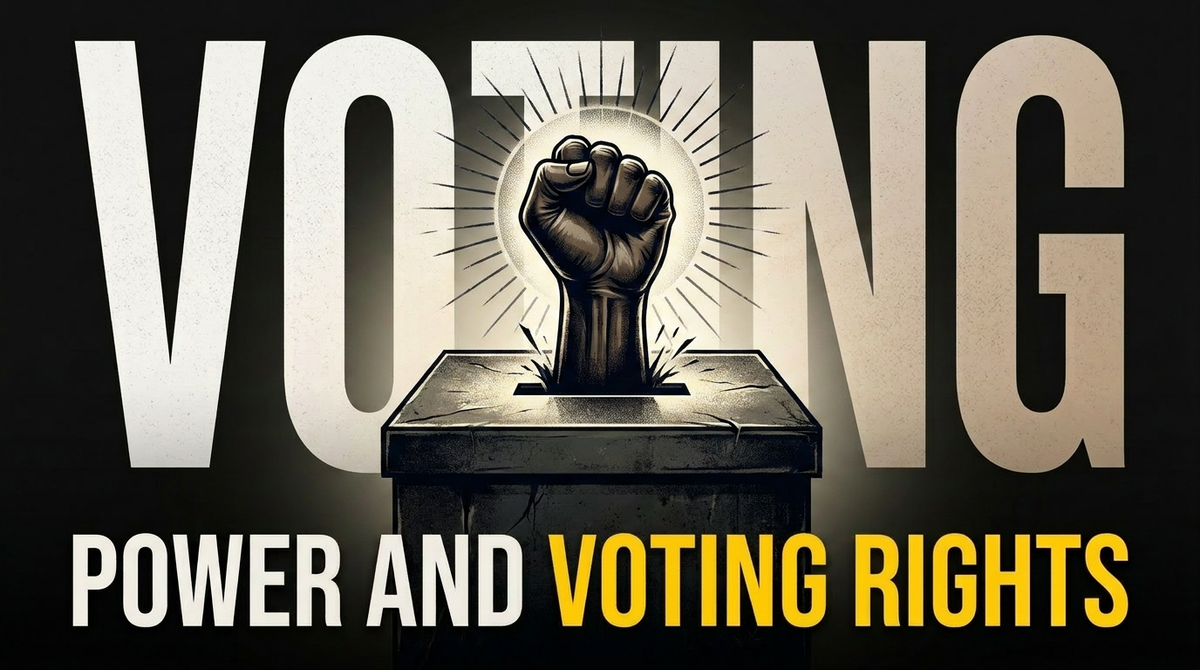
Voting is about power.
It is about who gets represented.
It is about who controls public resources.
It is about who shapes laws.
It is about who gets heard and who gets ignored.
That is why Black voting rights remain one of the most important issues in American democracy.
Voting Rights Are About More Than Election Day
Too many people reduce voting to one moment: standing in line, filling out a ballot, and submitting it.
But the power of voting does not end at the ballot box.
Voting affects school funding, housing policy, public safety, healthcare access, transportation, business development, criminal justice, and local budgets. It affects who sits on school boards, who becomes a judge, who prosecutes cases, who draws district lines, and who makes decisions about public money.
So when Black voting power is weakened, the consequences are not symbolic. They are practical.
They show up in underfunded schools.
They show up in neglected neighborhoods.
They show up in poor infrastructure.
They show up in lack of business investment.
They show up in policies created without the voices of the people most affected.
That is why the question must be deeper than, “Can we vote?”
The better question is:
Can we turn our votes into power?
A History Written in Struggle
To understand why this issue still matters, we have to look back.
After the Civil War, the Reconstruction era opened a new chapter in American democracy. The 15th Amendment, ratified in 1870, prohibited denying the right to vote based on race, color, or previous condition of servitude. The National Archives explains that the amendment granted African American men the right to vote.
That was a major constitutional victory.
But the right to vote did not automatically mean the right to exercise political power safely or equally.
During Reconstruction, Black men voted, held office, served in legislatures, and helped shape public life. But that growing Black political power was met with violent backlash. White supremacist organizations and political leaders worked to dismantle Reconstruction and restore control through intimidation, terrorism, and law.
That pattern matters.
Throughout American history, Black political progress has often been followed by organized efforts to limit, redirect, or neutralize Black political power.
After Reconstruction came Jim Crow.
Jim Crow was not just a social system of segregation. It was also a political system designed to control power. Southern states used poll taxes, literacy tests, intimidation, violence, and discriminatory rules to keep Black people from voting and to weaken their influence in government.
The National Archives notes that despite the 15th Amendment, African Americans in the South faced tremendous obstacles to voting.
That is why the Voting Rights Act of 1965 became necessary.
The Voting Rights Act Was a Response to Suppression
The Voting Rights Act of 1965 was not created because America suddenly became fair.
It was created because Black people organized, marched, challenged the system, and forced the nation to confront voter suppression.
The Act was passed to enforce the 15th Amendment and attack discriminatory voting practices. The National Archives identifies the Voting Rights Act as legislation created “to enforce the fifteenth amendment.”
This law became one of the most important civil rights protections in American history.
It challenged the tools that had been used to block Black voters. It gave the federal government stronger authority to confront discriminatory voting practices. It recognized that local and state governments could not always be trusted to protect the voting rights of Black citizens without federal oversight.
That history matters because it teaches us something powerful:
Rights do not protect themselves.
People have to defend them.
Communities have to organize around them.
Institutions have to be held accountable to them.
Modern Voter Suppression Looks Different
Today, voter suppression does not always look like a literacy test.
It does not always look like someone standing at the courthouse door saying, “You cannot vote.”
Sometimes it looks more technical.
Sometimes it looks like redistricting.
Sometimes it looks like polling place closures.
Sometimes it looks like voter-roll purges.
Sometimes it looks like strict voter ID rules.
Sometimes it looks like court decisions that weaken enforcement tools.
Sometimes it looks like district maps that reduce the political influence of Black communities.
This is why political literacy is necessary.
Because if people only understand the old forms of voter suppression, they may miss the modern ones.
One of the most important modern issues is vote dilution.
Vote dilution happens when people technically have the right to vote, but their collective voting strength is weakened by the way districts or election systems are structured.
In simple terms: you can vote, but the system can be arranged in a way that makes your vote less powerful.
That is why redistricting matters.
Redistricting is the process of drawing political district lines. Those lines help determine who represents a community, whose votes are grouped together, and whether voters have a fair opportunity to elect candidates of their choice.
This is not boring paperwork.
This is power.
Section 2 and the Fight Over Representation
Section 2 of the Voting Rights Act has been one of the key legal tools used to challenge voting systems that dilute the voting strength of communities of color. The Brennan Center explains that Section 2 has been used to secure fair representation in redistricting and vote dilution cases.
That matters because modern suppression often happens through systems that appear neutral on the surface.
A map may not say, “We are weakening Black voters.”
But if the effect of the map is to split Black communities apart or pack them into fewer districts so their influence is reduced, then the outcome still matters.
Impact matters.
History matters.
Patterns matter.
And this is why legal protections matter.
But those protections have been weakened.
In 2013, the Supreme Court’s decision in Shelby County v. Holder weakened a major enforcement mechanism of the Voting Rights Act. The Brennan Center states that the decision opened the door for states to enact restrictive voting laws, making it harder for people of color to vote.
That decision is one of the major reasons voting rights remain such a critical issue today.
Because once federal oversight was weakened, states had more room to change voting rules without the same level of pre-approval.
And that raises a serious question:
What happens when the communities most harmed by voting discrimination have fewer tools to challenge it?
The Bigger Issue: Voting Rights vs. Voting Power
The public conversation often focuses on whether people can vote.
But Black America must ask a deeper question:
Does our vote translate into power?
Can our vote shape policy?
Can our vote influence budgets?
Can our vote protect schools?
Can our vote hold police, prosecutors, judges, and elected officials accountable?
Can our vote help determine who receives public contracts and investment?
Can our vote defend our communities from neglect and exploitation?
Because if people can cast ballots but cannot influence outcomes, then we must ask whether voting rights are being reduced to symbolism.
And let’s be clear: voting alone is not enough.
Voting must be connected to political education.
Voting must be connected to local organizing.
Voting must be connected to candidate accountability.
Voting must be connected to policy demands.
Voting must be connected to economic power.
A community that votes but does not organize can still be ignored.
A community that organizes, studies, questions, and votes with strategy becomes much harder to dismiss.
Why Political Literacy Matters Now
Black communities need more than election-season slogans.
We need political literacy.
We need to understand what different offices actually do. We need to know the difference between federal, state, and local power. We need to know who draws district maps. We need to know how school boards operate. We need to know how local budgets are created. We need to know who funds candidates and what policies they support.
We need to ask better questions.
Not just: Who should I vote for?
But:
What policies do they support?
Who benefits from their agenda?
What is their record?
How will they protect voting rights?
How will they support Black business development?
How will they address housing, education, healthcare, and criminal justice?
How will they be held accountable after election day?
That is the difference between being politically emotional and being politically educated.
This Is Not About Blind Party Loyalty
This conversation should not be reduced to blind loyalty to any political party.
Black political power cannot be built on automatic loyalty without accountability.
The question is not, “Which party wants our vote?”
The question is, “What are we demanding in exchange for our political power?”
Black voters should not be treated as a guaranteed voting bloc that is courted during election season and ignored afterward.
Political respect comes from organization.
Political influence comes from strategy.
Political accountability comes from communities that know what they want, know what they are owed, and know how to measure whether leaders are delivering.
What Black Communities Can Do
The solution is not despair.
The solution is discipline.
First, we must study voting rights history. Reconstruction, Jim Crow, Selma, the Voting Rights Act, and modern redistricting battles should be part of our political education.
Second, we must pay attention to local government. School boards, city councils, prosecutors, judges, county commissions, and state legislatures often have direct influence over daily life.
Third, we must understand redistricting. District lines shape representation, and representation shapes resources.
Fourth, we must challenge candidates with serious questions. Symbolic language is not enough. We need policy, records, plans, and accountability.
Fifth, we must build civic habits year-round. Check registration. Know election deadlines. Study the ballot. Attend meetings. Follow local budgets. Support voter education efforts.
Voting is not the finish line.
Voting is one tool inside a larger strategy for power.
Conclusion: The Power Behind the Ballot
Black people did not fight for voting rights just to participate symbolically.
They fought for the ability to shape their communities, protect their families, influence laws, and build a future.
From Reconstruction to Jim Crow, from the Voting Rights Act to modern redistricting battles, the fight has always been bigger than access.
It has been about power.
So the question is not simply:
Can Black people vote?
The deeper question is:
Can Black people turn votes into power?
Power to influence policy.
Power to demand resources.
Power to protect communities.
Power to hold leaders accountable.
Power to build institutions.
Power to shape the future.
Our ancestors fought for access to the ballot.
Our generation must fight for the power behind the ballot.